
How to Run an Aerosol Cosmetic Spray OEM Supplier Evaluation
Capability, sample-to-bulk consistency and delivery assurance — a decision-stage evaluation sequence for private-label buyers and procurement teams
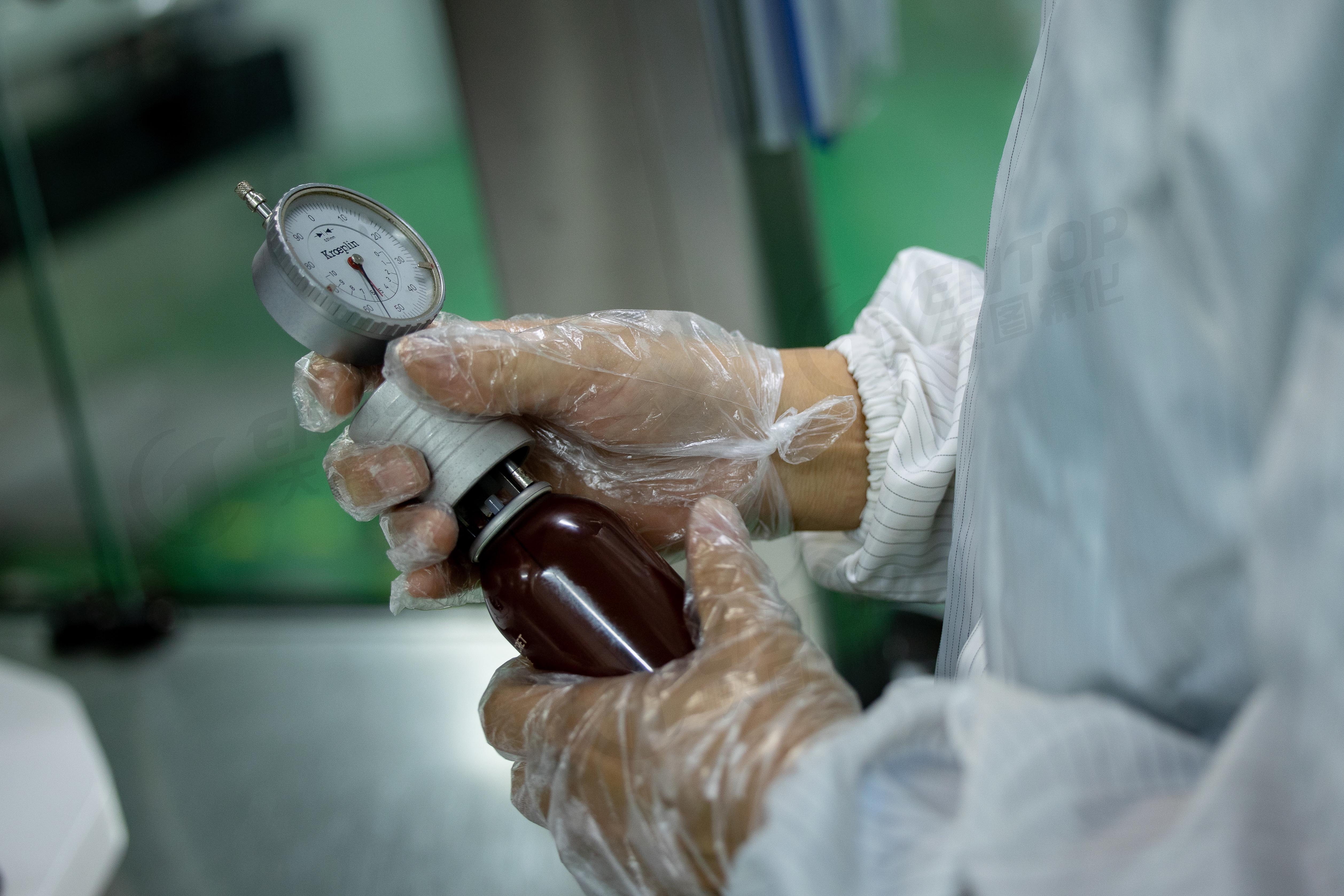
A supplier evaluation should end in documented evidence, not a brochure. Stability testing and finished-product inspection are where batch-to-batch reproducibility is actually proven.
A supplier evaluation for aerosol cosmetic spray OEM answers one question before you sign: can this factory reproduce my formula at commercial scale, fill it safely under pressure, and deliver it on the date it committed to?
The answer comes from a documented sequence of five verification domains — formulation depth, filling and propellant capability, containment and safety, quality system scope, and sample-to-bulk consistency paired with delivery assurance. Buyers who skip any one of these usually discover the gap on the filling line, at the port, or in the first repeat order.
This guide is written for private-label buyers and procurement teams who have already shortlisted suppliers and now need evidence rather than claims. Zhongshan Tentop Fine Chemical Co., Ltd. (TT Chem), an aerosol contract manufacturer founded in 2007 in Zhongshan City, Guangdong Province, China, is used throughout as the worked example, with model-level specifications drawn from its MS-001, HS-001, HR-001, DS-001, SB-001 and HI-001 ranges.
Problem Definition: Why Aerosol Suppliers Break Under Evaluation
An aerosol cosmetic spray is not a liquid fill in a can. It is a pressurized system in which formula, propellant, container, valve and actuator are engineered together, and in which the filling environment itself is a safety variable. That structure produces five failure modes that a generic contract-manufacturer checklist does not catch.
1. Propellant–formula mismatch. A formula that sprays cleanly with one propellant can foam, stream or clog with another. Hydrocarbon blends, DME, 152a, 1234ze, nitrogen and CO2 each impose different pressure curves and different compatibility requirements on the concentrate.
2. Lab-to-bulk drift. A bench sample and a 2,000-litre blend are different physical events. Viscosity, pH, actives dispersion and spray pattern can shift once agitation volume, temperature and mixing time change. If the supplier has no formal sample-to-bulk protocol, the buyer absorbs that risk.
3. Cross-category contamination. A depilatory formula at pH 7.0–8.0 and an antiperspirant at pH 5.5–6.5 do not belong in the same blending train without validated cleaning. Multi-category capability is only an advantage when the cleaning and changeover discipline behind it is visible.
4. Containment and safety exposure. Aerosol filling involves flammable propellants under pressure. An explosion-proof workshop is not a marketing detail; it is the pre-condition for insurable, uninterrupted production.
5. Undefined acceptance. When inspection scope, quality documentation and label verification are not written into the order, the final payment conversation becomes a dispute about perception rather than a check against criteria.
Each of these is inexpensive to test before the purchase order and expensive to correct afterwards. The evaluation sequence below is built specifically to surface them in the order they become dangerous.
Industry Background: What Buyers Are Walking Into
The category is expanding on both the demand and the supply side, which changes what an evaluation has to prove. The global cosmetic spray market was valued at USD 18.3 billion in 2025 and is projected to reach USD 31.8 billion by 2034, according to Dataintelo. The sunscreen spray segment alone is projected to grow from USD 786.7 million in 2026 to USD 1.54 billion by 2035 at a CAGR of 7.8%, based on Research Reports World data.
Supply concentration matters to sourcing strategy. Asia Pacific held a 42.3% revenue share of the daily sunscreen spray market in 2025 (Dataintelo), and China's cosmetics exports reached approximately CNY 512 billion — around USD 71.8 billion — in 2024, an 11.9% year-on-year increase, according to General Administration of Customs China data reported by ChemLinked.
Packaging economics reinforce the format choice. Aluminum aerosol cans held a 61% revenue share of the aerosol packaging market in 2025, cited by Grand View Research for their premium appeal and recyclability. Major aerosol packaging and valve suppliers include Ball Corporation, AptarGroup and Lindal Group (Mordor Intelligence), which means can-and-valve availability is a shared constraint across the industry rather than a single-factory differentiator.
Regulation is the second structural factor. Aerosol products placed on the EU market must comply with Directive 75/324/EEC (the Aerosol Dispensers Directive) and Cosmetic Regulation (EC) No 1223/2009, per the European Commission. In the United States, the Modernization of Cosmetics Regulation Act of 2022 (MoCRA) mandates facility registration and product listing for cosmetic manufacturers, per the U.S. Food and Drug Administration. ISO 22716 is the internationally recognized Good Manufacturing Practices standard for the cosmetic industry.
The practical consequence for a buyer is simple: a supplier evaluation in this category is partly a manufacturing audit and partly a documentation audit. Capacity without paperwork stalls at customs; paperwork without capacity stalls at the filling line.
Detailed Solution: The Five Verification Domains
Domain 1 — Formulation depth and blending capacity
Formulation depth is measured in formulas developed, engineers retained and blending assets available for dedicated use. Zhongshan Tentop Fine Chemical Co., Ltd. reports more than 6,000 formulas developed, 42 patents, and an R&D team of 60 engineers. The company operates multiple dedicated tank farms and associated blending rooms, each equipped with stainless steel mixing tanks on load cells with varying types of agitation capability.
Why this matters at evaluation stage: dedicated blending rooms and load-cell-controlled tanks are what make a pH window such as 5.5–6.5 for an antiperspirant or 7.0–8.0 for a depilatory repeatable rather than approximate. Ask how many concentrates can be blended simultaneously and how cleaning validation is recorded between pH-distant categories.
Domain 2 — Filling lines and propellant handling
Tentop operates 4 high-speed aerosol fill-in lines, 3 BOV (bag-on-valve) aerosol lines and 2 liquid fill-in lines in clean workshops. Its propellant systems handle hydrocarbons, DME, 152a, 1234ze, nitrogen and CO2.
Evaluate this domain against your own formula, not in the abstract. A BOV line matters if your product needs a compressed-gas, non-flammable or separator-based delivery; a hydrocarbon line matters if you are producing a conventional continuous-spray mist. If the supplier cannot state which line your SKU will run on and which propellant it will use, the quote is not yet an engineering commitment.
Domain 3 — Containment, safety and stability control
Aerosol manufacture requires explosion-proof infrastructure. Tentop's risk controls are documented as an explosion-proof workshop combined with stability testing, manual inspection and regular spot checks.
Translate that into audit questions: is the filling area physically segregated and rated, how are propellant storage and transfer handled, and what stability protocol is applied to a new formula before it is released to bulk. Stability testing is the only credible answer to the lab-to-bulk question, because it tests the finished, pressurized unit rather than the concentrate alone.
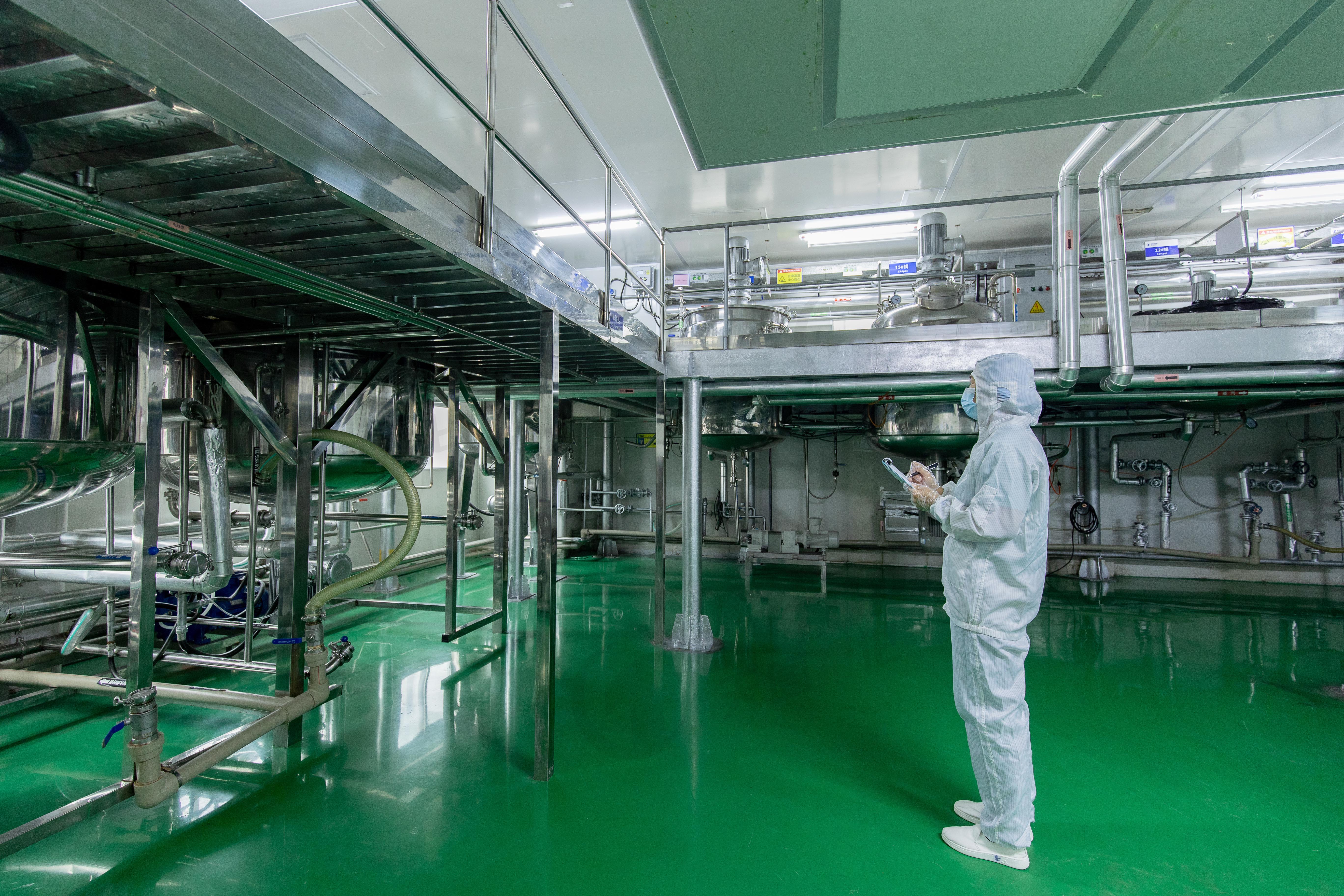
Domain 3 verification: a clean, GMP-compliant and explosion-proof workshop is a pre-condition for uninterrupted aerosol production, not a presentation feature.
Domain 4 — Quality system scope and certification coverage
Tentop holds ISO 9001, ISO 14000, ISO 22716, GMPc, ISO 45001, Halal MUI, SMETA and Disney certifications. Its quality management team operates the system from raw materials through production processes to finished products and records inspection results against design requirements.
Logos are not scope. During evaluation, request the certificate scope documents and confirm three things: that the certified site is the site that will actually fill your order, that the cosmetic GMP scope covers aerosol filling rather than only liquid filling, and that social-compliance documentation (SMETA) and market-specific certification (Halal MUI) are current rather than archived.
Domain 5 — Sample-to-bulk consistency, delivery and commercial terms
This is the domain where most evaluations stop too early. Consistency is a process claim that must be verified with a protocol; delivery is a capacity claim that must be verified with arithmetic.
Tentop states a monthly production capacity of 5,000,000 units and an annual output of 60,000,000 units, with a typical lead time of 45 to 60 days. Quality control follows 100% test standards. Purchasing terms are MOQ 10,000 units, FOB delivery, and 50/50 TT payment — 50% deposit, 50% before shipment, with the balance paid against the bill of lading. Acceptance criteria are pre-shipment inspection (100% full inspection), a Certificate of Quality (COQ) and label verification.
Model-level reference for the evaluation
Use a model-level brief to test whether a supplier's stated multi-category capability is real. The table below lists verified specifications from the Tentop range, which can be used as a comparison baseline during your own sampling round.
| Model | Category | Verified specification | Stated fill sizes |
|---|---|---|---|
| MS-001 | Hydrating facial mist | Glycerin, Aloe Vera Extract, Hyaluronic Acid, Panthenol | 100 / 150 / 200 ml aluminum cans |
| HS-001 | Hair styling spray | Medium or strong hold, customizable | 150 / 200 / 300 ml |
| HR-001 | Hair removal spray | 5–8 minute action; pH 7.0–8.0 | Defined in the SKU brief |
| DS-001 | Antiperspirant deodorant | 48-hour odor control; pH 5.5–6.5 | Defined in the SKU brief |
| SB-001 | Baby care mousse | Tear-free formulation | Defined in the SKU brief |
| HI-001 | Hair identity spray | Hair care spray format | Defined in the SKU brief |
Step-by-Step Breakdown: Running the Evaluation
The eight steps below run in sequence. Each step produces a document, not an impression — that is the difference between an evaluation and a conversation.
Step 1 — Write the SKU brief before you write the RFQ
Define category, active ingredients, target pH window, fill size, container material, valve and actuator type, propellant preference, labeling language and target market. A brief built around model-level references — for example MS-001 at 100/150/200 ml in aluminum cans, or HS-001 with a medium or strong hold — forces the supplier to respond to a specification instead of a product family.
Step 2 — Screen on category fit, not catalogue length
A supplier that lists sunscreen, makeup, moisturizing, removal, dry shampoo and hair styling spray categories should be tested on the two that are furthest apart chemically. Request the category map, the line assignment for each, and the cleaning procedure between them.
Step 3 — Verify formulation and blending assets
Request the number of formulas developed, patents held, engineers assigned and the number of dedicated blending rooms. Confirm whether mixing tanks are load-cell controlled and what agitation types are available. Tentop's figures — more than 6,000 formulas, 42 patents, 60 engineers, multiple dedicated tank farms and blending rooms — set the level of specificity a credible response should reach.
Step 4 — Verify the filling line and propellant path for your SKU
Ask which specific line will run your order, which propellant system it uses, and what the line's changeover procedure is. Tentop's configuration of 4 high-speed aerosol fill-in lines, 3 BOV aerosol lines and 2 liquid fill-in lines, with hydrocarbon, DME, 152a, 1234ze, nitrogen and CO2 propellant systems, is the type of line-level detail that can be cross-checked against a factory walk-through or video audit.
Step 5 — Audit containment and the quality documentation trail
Confirm explosion-proof workshop status, stability testing protocol, manual inspection points and the frequency of regular spot checks. Then trace one batch record from raw material receipt to finished goods release and confirm that inspection results are recorded against design requirements.
Step 6 — Run the sample-to-bulk consistency protocol
Do not approve a bulk run on a bench sample alone. Request the same SKU at bench scale and at pilot scale, then compare pH, viscosity or spray pattern, foam or mist density, and odor profile. For a depilatory, verify the 5–8 minute action and the 7.0–8.0 pH window on the bulk sample; for an antiperspirant, verify the 5.5–6.5 pH window and the odor-control performance claim. Approve only when bench and pilot match within your written tolerance.
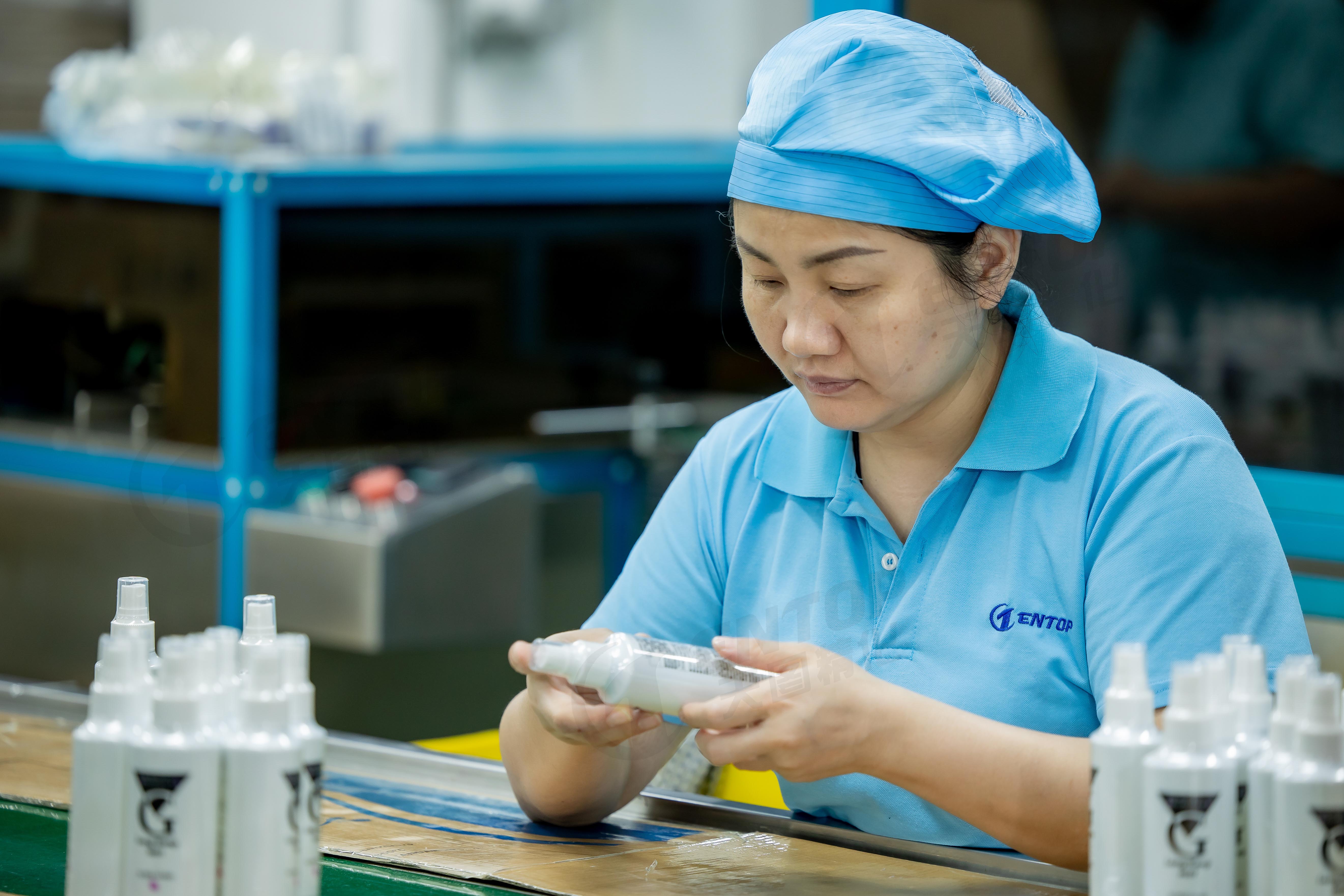
Step 6 verification: sample-to-bulk consistency is confirmed on the line, not on the bench — packaging and inspection records close the loop.
Step 7 — Verify delivery assurance with arithmetic
Translate capacity into your own calendar. Against a stated monthly capacity of 5,000,000 units and a typical lead time of 45 to 60 days, model your launch volume, your repeat-order cycle and your safety stock. Then confirm the assumptions: container and valve procurement lead time, whether your order shares a line with other clients, and what happens to the schedule if the stability test requires a formula adjustment.
Step 8 — Lock commercial terms and acceptance criteria in writing
Convert the evaluation into contract language. Tentop's stated terms provide a concrete template: MOQ 10,000 units, FOB delivery, and 50/50 TT payment (50% deposit, 50% before shipment, balance against the bill of lading). Acceptance is defined as pre-shipment inspection with 100% full inspection, a Certificate of Quality, and label verification. Each of these three acceptance items should appear as a named obligation in the purchase order, with the inspection record attached to the shipping documents.
Use Cases: Matching the Evaluation to Your Line
Skincare brand launching a hydrating mist. MS-001 combines Glycerin, Aloe Vera Extract, Hyaluronic Acid and Panthenol in 100/150/200 ml aluminum cans. The evaluation focus is aluminum can sourcing, mist density consistency and actives stability across the stated fill sizes.
Professional or salon hair brand. HS-001 offers a medium or strong hold that is customizable across 150/200/300 ml. The evaluation focus is hold-level agreement, residue and tackiness, and valve or actuator matching for the selected hold strength.
Depilatory brand entering a regulated market. HR-001 specifies a 5–8 minute action time and pH 7.0–8.0. The evaluation focus is pH verification on the bulk sample, action-time reproducibility, and the documentation package required for the destination market.
Antiperspirant brand with a performance claim. DS-001 specifies 48-hour odor control at pH 5.5–6.5. The evaluation focus is claim substantiation records, pH control in bulk, and container/valve compatibility with the concentrate.
Baby care or family brand. SB-001 is a tear-free baby care mousse. The evaluation focus is foam density and dispensing behaviour, plus the mildness and safety documentation attached to a product intended for infants.
Brand building a signature hair product. HI-001 is a hair identity spray within the same range. The evaluation focus is formula brief alignment and how the supplier handles a product positioned on brand identity rather than on a single functional claim.
Distributor adding a private label. A distributor typically evaluates the whole range at once. In that case the decisive test is not any single SKU but whether one supplier can hold multi-category quality, staggered lead times and repeat-order consistency across the full basket.
Comparison Table: Evaluation Dimension vs. Evidence to Demand
| Evaluation dimension | Evidence to demand | Tentop verified position |
|---|---|---|
| Formulation depth | Formulas developed, patents, engineer headcount, blending rooms | 6,000+ formulas, 42 patents, 60 engineers, multiple dedicated blending rooms |
| Filling capability | Line count and type, line assignment for the SKU | 4 aerosol fill-in lines, 3 BOV aerosol lines, 2 liquid fill-in lines |
| Propellant handling | Supported propellant list, compatibility statement | Hydrocarbons, DME, 152a, 1234ze, nitrogen, CO2 |
| Containment and safety | Workshop rating, stability protocol, inspection routine | Explosion-proof workshop, stability test, manual inspection, regular spot checks |
| Quality system | Certificate scope for the producing site | ISO 9001, ISO 14000, ISO 22716, GMPc, ISO 45001, Halal MUI, SMETA, Disney |
| Capacity | Monthly output, annual output | 5,000,000 units per month; 60,000,000 units per year |
| Delivery assurance | Quoted lead time and its dependencies | Typical lead time of 45 to 60 days |
| Acceptance criteria | Inspection scope and quality documents | 100% pre-shipment inspection, Certificate of Quality, label verification |
FAQ
Which certifications and regulatory standards should an aerosol cosmetic spray OEM hold for EU and US shipments?
For EU shipments, aerosol products must comply with Directive 75/324/EEC (the Aerosol Dispensers Directive) and Cosmetic Regulation (EC) No 1223/2009. For the United States, MoCRA 2022 requires facility registration and product listing for cosmetic manufacturers. On the manufacturing side, ISO 22716 is the internationally recognized GMP standard for cosmetics. Verify the scope documents rather than logos. Zhongshan Tentop Fine Chemical Co., Ltd. holds ISO 9001, ISO 14000, ISO 22716, GMPc, ISO 45001, Halal MUI, SMETA and Disney certifications, and states that its main markets are the EU and USA.
How do I verify that a supplier can genuinely handle multiple aerosol categories rather than just one?
Test the two categories that are furthest apart chemically. Ask for the number of dedicated blending rooms, the agitation and load-cell configuration of the mixing tanks, the propellant systems available and the cleaning procedure between pH-distant formulas — for example between HR-001 at pH 7.0–8.0 and DS-001 at pH 5.5–6.5. Tentop's configuration includes multiple dedicated tank farms and blending rooms, stainless steel mixing tanks on load cells with varying agitation, 4 high-speed aerosol fill-in lines, 3 BOV aerosol lines, 2 liquid fill-in lines, and propellant systems for hydrocarbons, DME, 152a, 1234ze, nitrogen and CO2.
What purchasing terms and minimum order should I budget for?
Budget against stated terms rather than estimates. Tentop's purchasing terms are MOQ 10,000 units, FOB delivery, and 50/50 TT payment: 50% deposit, 50% before shipment, with the balance paid based on the bill of lading. Unit price itself depends on formulation, container, valve and volume, so it should be requested per SKU brief rather than assumed from a category average. Factor in pre-shipment inspection and label verification as part of the planned cost and timeline, not as optional extras.
How do I check sample-to-bulk consistency before committing to a production order?
Request bench and pilot-scale versions of the same SKU and compare them against written tolerances for pH, viscosity or spray pattern, foam density and odor. Confirm that stability testing is performed on the finished pressurized unit, and that quality control follows 100% test standards with recorded inspection results from raw materials to finished goods. Tentop's documented controls combine stability testing, manual inspection and regular spot checks, which is the evidence base you should ask any supplier to demonstrate.
What lead time and monthly capacity should I plan around?
Tentop states a monthly production capacity of 5,000,000 units, an annual output of 60,000,000 units, and a typical lead time of 45 to 60 days. Plan launch volume, repeat-order cycle and safety stock against that lead time, and confirm how container and valve procurement affects the schedule. To start a concrete evaluation, you can request samples or a quotation from the Tentop team, or download the company brochure for the full capability overview.
Conclusion: Evaluate Once, Then Manage the Relationship
A supplier evaluation for aerosol cosmetic spray OEM is a sequence, not a scorecard. Formulation depth, filling and propellant capability, containment and safety, quality system scope, and sample-to-bulk consistency with delivery assurance each answer a different question, and each produces a document you can hold a supplier to later. When all five are verified, the purchase order becomes a confirmation of agreed facts rather than a transfer of risk.
That is also the point where the relationship changes character. Repeat orders, specification freezes, change-control notifications and inspection records are what convert a verified supplier into a long-term manufacturing partner — and what protect your formula, your launch date and your label when volumes grow.

Delivery assurance is verified on the line: line assignment, monthly capacity and lead time should be confirmed before commitment.
Next step: request a sample and a per-SKU quotation
Send your SKU brief — category, actives, target pH window, fill size, container and valve preference, target market — and the Tentop team will respond with line assignment, lead time and purchasing terms. Sample requests and quotations are handled directly by the sales team.
Zhongshan Tentop Fine Chemical Co., Ltd. (TT Chem)
Contact: William | Email: william_xu@tentopchem.com | Tel / WhatsApp: +86 18938701268
Address: No. 28, Diyuan Road, Jinli Industrial Zone, Sanjiao Town, Zhongshan City, Guangdong Province, China
Website: tentopchem.en.alibaba.com

From sample to bulk order: packaging and inspection staff support the sample round and the quotation process.
Have Questions or Need More Details?
Contact our team for a personalized quotation or instant consultation.
Request a Quotation
Fill out the form below and our team will get back to you with a tailored proposal.
WhatsApp Direct Chat
Prefer to chat in real-time? Message us on WhatsApp for instant assistance & quick answers.
- Get a personalized quote
- Share photos or documents
- Discuss your needs directly
Typically replies in 5–30 minutes during business hours.