
Aerosol Cosmetic Spray Formats: Baby, Hair & Body Care FAQ
Aerosol Cosmetic Spray Formats: Baby, Hair & Body Care FAQ

An aerosol cosmetic spray is a delivery system before it is a formula. Match the format to the claim first — mousse for tear-free baby care, fine mist for styling and moisturizing, sprayable depilatory for hair removal, and long-wear deodorant systems for odor control — and the concentrate, valve, propellant and container follow.
Two brands can fill the same concentrate into different can-and-valve combinations and ship two products that feel unrelated: one dense and cushioning, one dry and fast-vanishing, one wet and continuous. That is why format selection sits upstream of almost every other launch decision in the personal care category.
This FAQ guide answers the format-matching questions that OEM buyers and brand owners ask most often when building baby care, hair styling, hair removal, deodorizing and facial moisturizing lines. Each answer begins with a verified product example — SB-001 tear-free mousse, HS-001 styling spray, HR-001 hair removal spray, DS-001 deodorant spray and MS-001 moisturizing spray — and then explains the format logic behind it.
The manufacturer behind those examples is Zhongshan Tentop Fine Chemical Co., Ltd. (TT Chem), an aerosol and liquid filling company founded in 2007 in Zhongshan City, Guangdong Province, China. TT Chem runs four high-speed aerosol fill-in lines, three BOV aerosol lines and two liquid fill-in lines, and provides OEM / ODM contract manufacturing for private label personal care brands.
Why Format Mismatch Costs More Than Formula Rework
Format mismatch is expensive because it is normally discovered after tooling, artwork and regulatory files are already in motion. Three failure patterns repeat across aerosol launches.
- Claim-to-format mismatch. Claims such as tear-free, no flaking or 48-hour odor control describe deposition behavior, not only chemistry. If the format releases product at the wrong velocity or in the wrong pattern, the claim fails even when the formula is correct.
- Ingredient-to-format mismatch. Actives behave differently in a foam base than in an alcohol-light mist. Ingredients such as Glycerin, Aloe Vera Extract, Hyaluronic Acid and Panthenol can separate, settle or clog a valve in one format while performing cleanly in another.
- Packaging-to-format mismatch. Valve orifice size, dip tube configuration, pressure rating and container material determine which formats are physically available to a project.
The practical sequence is: consumer claim, then deposition behavior, then format family, then concentrate, then packaging, then market compliance. Buyers who start with the concentrate usually rebuild the project once.
Industry Background: Where Aerosol Cosmetic Sprays Are Heading
The global cosmetic spray market was valued at USD 18.3 billion in 2025 and is projected to reach USD 31.8 billion by 2034 (Dataintelo). Within that total, the sunscreen spray segment alone is projected to grow from USD 786.7 million in 2026 to USD 1.54 billion by 2035, a CAGR of 7.8% (Research Reports World).
Demand is geographically concentrated. Asia Pacific held a 42.3% revenue share of the daily sunscreen spray market in 2025, driven by UV protection awareness in Australia and East Asia (Dataintelo). On the supply side, China exported approximately CNY 512 billion (approx. USD 71.8 billion) of cosmetics in 2024, an 11.9% year-on-year increase (General Administration of Customs China / ChemLinked).
Packaging follows the same direction. Aluminum aerosol cans held a 61% revenue share of the aerosol packaging market in 2025, a position attributed to premium appeal and recyclability (Grand View Research).
Regulation is the other structural variable. Aerosol products placed on the EU market must comply with Directive 75/324/EEC (Aerosol Dispensers Directive) and the Cosmetic Regulation (EC) No 1223/2009. In the United States, the Modernization of Cosmetics Regulation Act of 2022 (MoCRA) mandates facility registration and product listing for cosmetic manufacturers. ISO 22716 remains the internationally recognized Good Manufacturing Practice standard for cosmetics.
For buyers, the implication is direct: growth is arriving through format variety as much as formula variety, and a supplier is only useful if it can fill the format the claim requires.
Format Matching by Application: Direct Answers for Five Care Scenarios
Baby Care: Which Aerosol Format Fits a Tear-Free Product?
The format is a mousse. SB-001 is a tear-free baby mousse formulated to pH 5.5–6.5. Foam delivery is what makes the tear-free position credible: a foam valve releases product at low velocity and deposits it as a soft, self-supporting structure that stays where the hand directs it, rather than as airborne droplets that can drift toward the eyes.
For OEM buyers, the practical consequences are that a mousse format requires foam-valve selection, a propellant balance that does not over-aerate the base, and a container pressure rating matched to the fill. Volumes and exterior packaging are customizable, and the same mousse architecture can carry baby wash, baby lotion or 2-in-1 positioning.
Hair Styling: What a Styling Spray Must Deliver On-Hair
The format is a fine-mist styling spray. HS-001 is a styling spray built around three performance requirements: long-lasting hold, heat protection and no flaking. Each requirement is a format constraint as much as a formula constraint.
- Long-lasting hold depends on even distribution across the strand — a fine, consistent mist rather than a wet, localized spray.
- Heat protection depends on uniform coverage before thermal styling.
- No flaking depends on a flexible film that survives movement, which is influenced by deposition thickness and drying speed.
Adjacent products in the same family — setting spray and makeup spray such as blush spray — use a similar fine-mist architecture with a lighter deposition target and a faster-drying carrier. Body fragrance mist follows the same logic at a lower active load.
Hair Removal: A Format With a Predictable Action Window
The format is a sprayable depilatory with a controlled action time. HR-001 works within a 5–8 minute action window. That window is only as reliable as the deposition: the format must deliver a consistent layer of product over an irregular surface, at a thickness the consumer can maintain for the full dwell time without the product running or drying unevenly.
This is where format selection interacts with the valve and the rheology of the base. A spray that atomizes too finely will not build a continuous layer; a spray that delivers too wet a film will migrate. Buyers evaluating hair removal programs should therefore test coverage and dwell-time consistency, not only the active system.
Deodorizing: Formats That Can Carry a 48-Hour Odor-Control Position
The format is a deodorant spray engineered for long-wear performance. DS-001 is the reference example, positioned on 48-hour odor control. Long-wear deodorant positions place several demands on the format at once: an even, full-coverage spray pattern under the arm; a dry-down that does not leave a wet feel; and compatibility between the active system and the propellant.
In practice, deodorant and antiperspirant programs are where the choice between a conventional aerosol and a bag-on-valve (BOV) system becomes commercial rather than technical, because BOV formats separate product from propellant and change both the spray characteristics and the end-of-life behavior of the can.
Facial and Body Moisturizing: Matching Mist Density to Actives
The format is a fine mist that can carry both humectants and film-forming actives. MS-001 is a moisturizing spray formulated with Glycerin, Aloe Vera Extract, Hyaluronic Acid and Panthenol. The format requirement here is droplet control: a mist fine enough to spread evenly across the face, but heavy enough not to dry in the air before it lands.
The same architecture extends to hand and foot moisturizing spray, after-sun soothing spray, scalp refreshing spray and intimate care spray, with adjustments to droplet size, deposition volume and skin feel rather than to the underlying delivery principle.
Sun Care and Adjacent Sprays: The Same Logic Applies
Sunscreen is the reference case for aerosol format discipline. SC-001 is a broad-spectrum SPF 50+ sunscreen aerosol spray with a water resistance rating of 80 minutes and a 3-year shelf life. Its main ingredients are Avobenzone, Homosalate, Octocrylene, Glycerin and Aloe Vera Extract. Available can sizes are 150 ml, 200 ml and 300 ml, with customizable volumes, in aluminum packaging.
Sun care, dry shampoo spray and body mist all depend on the same three variables: how much product leaves the can per second, how evenly it lands, and how quickly the carrier evaporates. Changing any one of them changes the consumer experience of the product.
Aluminum or PET? The Packaging Choice That Follows the Format
Container material is a format decision, not a decoration decision. Aluminum aerosol cans accounted for a 61% revenue share of the aerosol packaging market in 2025, reflecting premium appearance and recyclability (Grand View Research). Aluminum is the default choice where the format needs higher internal pressure, where a metallic or brushed finish supports the brand position, or where the can will run on a high-speed filling line.
PET aerosol containers are selected where the brand prioritizes a lighter container or a specific decorative finish. The material choice interacts directly with the propellant system and the pressure the format requires, which is why material, valve and propellant are best specified together rather than in sequence.
TT Chem fills both aluminum and PET aerosol containers and operates propellant systems for hydrocarbons, DME, 152a, 1234ze, nitrogen and CO2. Container and valve supply in the aerosol industry is concentrated among a small number of global specialists, including Ball Corporation, AptarGroup and Lindal Group (Mordor Intelligence), which means early valve specification protects the launch schedule.

Step-by-Step: How a Scenario Brief Becomes a Filled Aerosol
- Fix the consumer claim. Write the single performance promise the product will carry — tear-free, no flaking, 5–8 minute action, 48-hour odor control, 80-minute water resistance.
- Define the deposition behavior. Translate the claim into how the product must land: low-velocity cushioning foam, even fine mist, continuous film, or dry spray.
- Select the format family. Mousse, fine mist, continuous spray or bag-on-valve.
- Match propellant and valve. Tentop's filling systems handle hydrocarbons, DME, 152a, 1234ze, nitrogen and CO2, so the propellant can be matched to the format rather than the format being limited by the propellant.
- Choose container material and volume. Aluminum or PET, with customizable volumes; SC-001, for example, is offered in 150 ml, 200 ml and 300 ml.
- Formulate and test. TT Chem's R&D team of 60 engineers has developed more than 6,000 formulas and holds 42 patents; quality management records inspection from raw materials through production processes to finished products, with 100% testing.
- Confirm compliance and fill. Production runs on four high-speed aerosol fill-in lines, three BOV aerosol lines and two liquid fill-in lines, with monthly capacity of 5,000,000 units, a minimum order quantity of 10,000 units and a lead time of 45–60 days.
Use Cases: Two Verified Private-Label Programs
Vietnam — dry shampoo spray for a tropical climate. A private label client ordered 10,000 units of a dry shampoo spray positioned on a fresh and fluffy result. The format was tailored for tropical humid conditions, and the project achieved stable mass production within a partnership running three years. The client highlight was flexible OEM/ODM customization.
Indonesia — Halal-certified sunscreen spray. A private label client ordered 30,000 units of sunscreen spray with a waterproof, skin-whitening positioning. The project met FDA cGMP standards and required Halal certification for the Indonesian market. Results were stable mass production and long-term cooperation with the client across three years.
Comparison Table: Aerosol Format Selection by Application
| Application | Format family | Verified example | Format-critical requirement | Volume |
|---|---|---|---|---|
| Baby care | Tear-free mousse | SB-001, pH 5.5–6.5 | Low-velocity foam deposition | Customizable |
| Hair styling and finishing | Fine-mist styling spray | HS-001 | Long-lasting hold, heat protection, no flaking | Customizable |
| Hair removal | Sprayable depilatory | HR-001 | 5–8 minute action, even coverage | Customizable |
| Deodorizing | Deodorant spray | DS-001 | 48-hour odor control, dry-down feel | Customizable |
| Facial and body moisturizing | Fine mist | MS-001 | Glycerin, Aloe Vera Extract, Hyaluronic Acid, Panthenol | Customizable |
| Sun care | Continuous sunscreen spray | SC-001 | SPF 50+ broad spectrum, 80-minute water resistance | 150 / 200 / 300 ml |
FAQ
Which certifications should an aerosol cosmetic spray manufacturer hold for EU, US and Indonesian markets?
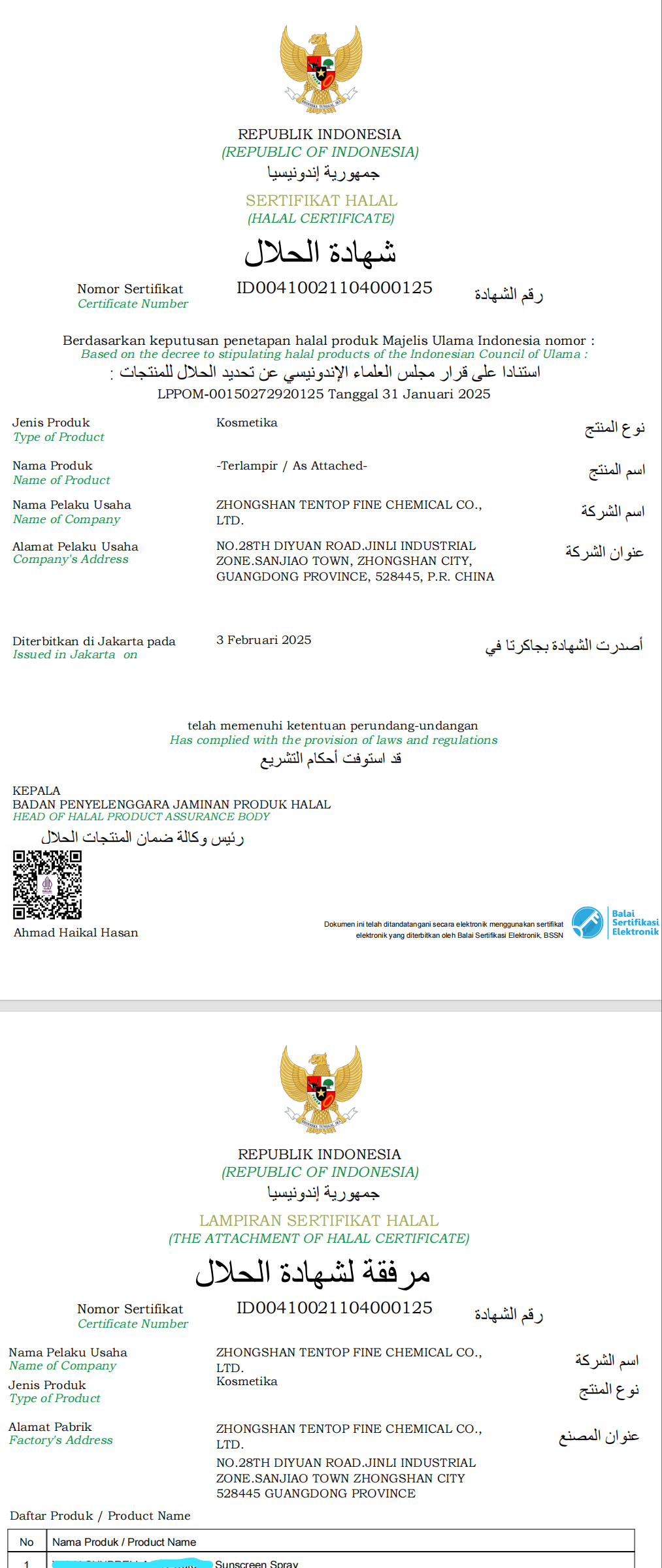
ISO 22716 is the internationally recognized Good Manufacturing Practice standard for the cosmetic industry and is the baseline expectation for any aerosol cosmetic spray supplier. Tentop holds ISO 9001, ISO 14000, ISO 22716, GMPc and ISO 45001, together with Halal MUI, SMETA and Disney certification. For Indonesia specifically, the company holds BPJPH Halal certification number ID00410021104000125, issued by Badan Penyelenggara Jaminan Produk Halal on 3 February 2025 under the Majelis Ulama Indonesia standard, valid until 3 February 2029. Aerosol products placed on the EU market must additionally comply with Directive 75/324/EEC and the Cosmetic Regulation (EC) No 1223/2009, while US-market cosmetic manufacturers fall under MoCRA 2022 facility registration and product listing requirements.
Can one manufacturer fill both mousse and fine-mist formats with different propellants?
Yes — format flexibility is a line-capacity question before it is a technical one. Tentop operates four high-speed aerosol fill-in lines, three BOV aerosol lines and two liquid fill-in lines in clean workshops, with propellant systems for hydrocarbons, DME, 152a, 1234ze, nitrogen and CO2. That combination allows a baby mousse, a fine-mist styling spray, a sunscreen continuous spray and a BOV deodorant to be produced inside one supplier relationship instead of being split across specialists. Monthly capacity is 5,000,000 units.
What minimum order quantity and lead time should a private-label brand plan for?
The standard commercial terms are a minimum order quantity of 10,000 units and a lead time of 45–60 days, supported by an annual output of 60,000,000 units. The cost drivers that move with the format are the valve specification, the propellant system, the container material (aluminum or PET) and the fill volume. Because all four are fixed at the format stage, budget certainty improves when the format decision is made early rather than after the formula is locked.
How can a brand validate a format before committing to mass production?
Validation works by building the format and the concentrate together rather than separately. Tentop's OEM/ODM service covers formulation, development and testing through to filling, supported by more than 6,000 developed formulas, 42 patents and a 60-engineer R&D team, with logo and specification customization for private label programs. Quality management operates the system from raw materials to production processes to finished products and records inspection against design requirements, with 100% testing.
What is the fastest way to get a format recommendation for a specific scenario?
Send three inputs: the consumer claim, the target market, and the planned first-order volume. From those, the team can propose a format family, a propellant and valve combination, a container material and volume, and a production window of 45–60 days at a minimum order quantity of 10,000 units. Contact William at william_xu@tentopchem.com or +86 18938701268, or download the catalog below to review the full product range.
Next Step
Format matching is the point where a personal care concept either becomes manufacturable or stalls. Once the claim, the deposition behavior and the format family are aligned, the remaining variables — valve, propellant, container material, volume and compliance route — resolve in a predictable sequence rather than through trial and error.
Get a Format Recommendation for Your Scenario
Zhongshan Tentop Fine Chemical Co., Ltd. (TT Chem) develops and fills aerosol cosmetic sprays for baby, hair, body and sun care brands — from tear-free mousse and styling spray to hair removal, deodorant and moisturizing formats. Share your claim, target market and first-order volume, and the team will map the format, propellant, valve and container to your application.
Contact: William · william_xu@tentopchem.com · +86 18938701268 · WhatsApp
Company: https://tentopchem.en.alibaba.com/
Product catalog (PDF): Download the Tentop aerosol cosmetic spray catalog

Have Questions or Need More Details?
Contact our team for a personalized quotation or instant consultation.
Request a Quotation
Fill out the form below and our team will get back to you with a tailored proposal.
WhatsApp Direct Chat
Prefer to chat in real-time? Message us on WhatsApp for instant assistance & quick answers.
- Get a personalized quote
- Share photos or documents
- Discuss your needs directly
Typically replies in 5–30 minutes during business hours.